BestStartBiz

34-page guide · instant download

The DIY Credit Repair & Credit Score Blueprint

How to dispute credit report errors, remove inaccurate negative items, rebuild your credit and get funding, with FCRA dispute letters and a 90-day action plan.

TRADELINE DETAIL · SAMPLE
Furnisher
Status
DOFD
Balance
COLLECTION AGY
CHARGE-OFF
03/2019
$2,847
Can they prove they own it?Chapter 3
Is it re-reporting monthly?Chapter 2
Is the clock expired?Chapter 2
Is the math itemized?Chapter 3

Four fields. Four separate legal arguments. Most people dispute the whole line as “not mine” and get a form letter back.

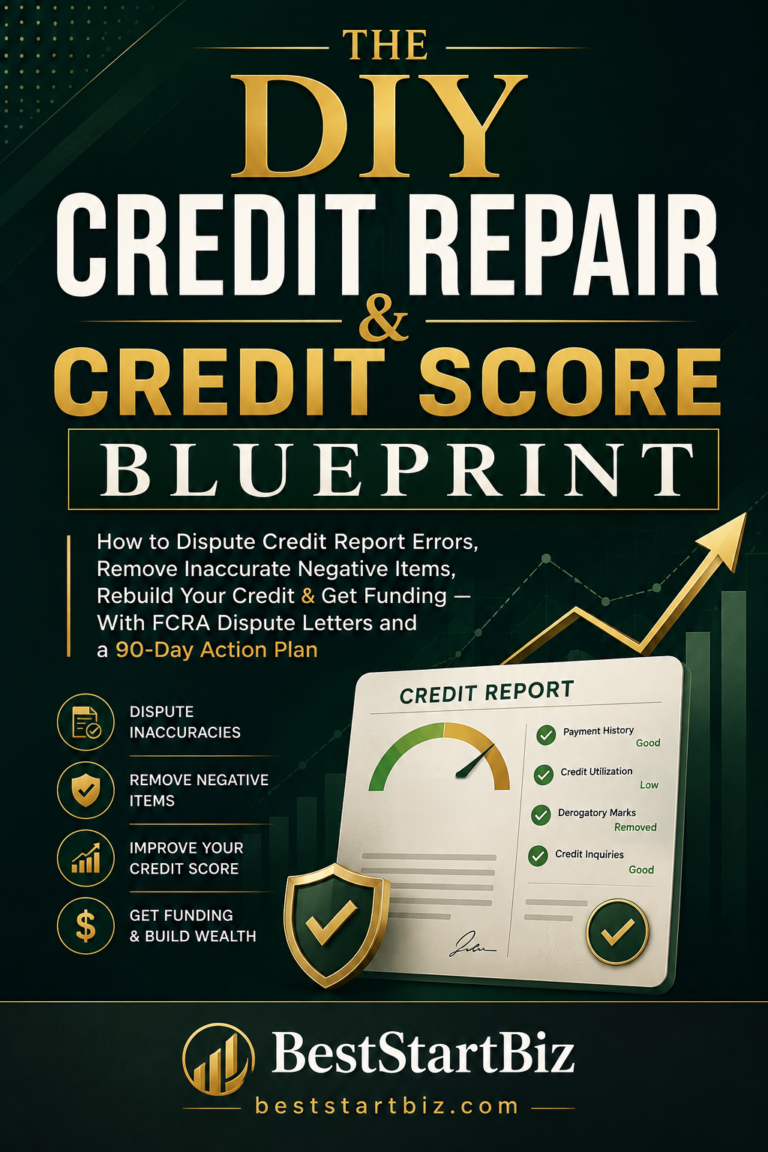
Cover of The DIY Credit Repair and Credit Score Blueprint by BestStartBiz

Most credit ebooks repeat a rule that was struck down in July 2025. This one does not. Every citation was checked against current law, and the three most repeated errors in this niche are corrected in the text.

$17

One-time payment. Instant PDF download.

Get the blueprint

Searchable PDF · 5 letter templates · 3 printable trackers · reads on any device

The reason nothing changes

You already have the legal right. Nobody taught you how to use it.

Roughly one in four consumers has an error on at least one credit report, and one in twenty has a mistake large enough to change the price of a loan. The Fair Credit Reporting Act says every item in your file has to be accurate, verifiable and current, and that if a bureau cannot verify a disputed item, it has to come off.

So why do most people get nowhere? Because they send the same letter for every item. A charge-off, a repossession, a medical collection and a tenant screening judgment each have completely different weak points, and a generic “this is not mine” dispute earns a generic denial on all four.

Then there is the other half of the problem. Even if you deleted every removable item tomorrow, a clean report with no positive history is a file no lender can evaluate. Deleting is defense. Building is offense. Almost every credit guide sold online covers only the first one.

This one covers both. Eleven chapters on removing inaccurate items, then eight chapters on rebuilding the score, including the chapter on turning personal credit into business credit that actually gets you funded.

What is inside

Twenty-five chapters, organised the way you will actually work

Every chapter in Part One follows the same shape: what the item is, the specific statute that protects you, the step-by-step play, and how you know you have won.

Part One. Clean it up

  1. 01Hard inquiries and permissible purpose
  2. 02Charge-offs and the date of first delinquency
  3. 03Third-party collections and debt validation
  4. 04Bankruptcies and method of verification
  5. 05Late payments and the furnisher ledger
  6. 06Student loans, rehabilitation and discharge
  7. 07Repossessions and deficiency balances
  8. 08Evictions and tenant screening reports
  9. 09Medical collections and what really applies now
  10. 10Child support arrears and obsolescence
  11. 11Reinsertions and the five-day notice rule

Part Two. Build it up

  1. 12What actually moves your credit score
  2. 13The utilization play and statement closing dates
  3. 14Goodwill letters for accurate late payments
  4. 15Building from a thin or no-credit file
  5. 16Account age, credit mix and the long game
  6. 17Inquiry discipline and rate-shopping windows
  7. 18Negotiating without restarting the clock
  8. 19From personal credit to business credit

Part Three. Run the play

  1. 20The 90-day action plan
  2. 21Escalation when they ignore you
  3. 22Traps, scams and bad advice to refuse
  4. 23Five fill-in letter templates
  5. 24Dispute log and utilization trackers
  6. 25Plain-English glossary

Chapter 23

The five letters that do the work

Written out in full, ready to fill in. The PDF has a real text layer, so you can copy them straight out of the file instead of retyping them.

Each one cites the specific section of the FCRA or FDCPA it relies on, so the person opening your envelope knows immediately that you know what you are asking for.

  • General dispute to the bureauThe workhorse. Cites sections 1681i and 1681e(b).
  • Method of verification demandWhat you send after they come back “verified.” Section 1681i(a)(7).
  • Debt validation to a collectorDemands the contract and the Regulation F itemization. Section 1692g.
  • Goodwill adjustment requestFor accurate late payments a dispute will never remove.
  • Reinsertion violation noticeWhen a deleted item comes back. Section 1681i(a)(5)(B).

Chapter 20

A 90-day plan so you do not quit in week three

The most common failure is disputing everything at once, receiving five form letters, and giving up. This is the order that avoids it.

Days 1-7

Pull all three reports free, build the folder and the log, tag every negative item to its chapter.

Days 1-7

Find every statement closing date and fix utilization, the fastest legitimate movement available to you.

Days 8-21

Send your strongest disputes first: obsolete items, wrong dates, accounts that are not yours.

Days 22-35

Open the secured card or credit-builder loan if your file is thin. Set autopay. Open nothing else.

Days 30-45

Sort the responses into deleted, corrected and verified. Send method-of-verification demands on anything verified.

Days 45-60

Validation letters to collectors. Goodwill letters to original creditors on accurate lates.

Days 60-75

Negotiate the debts that are genuinely yours, after you check your state limitations period.

Days 75-90

Re-pull all three, compare against day one, watch for reinsertions, escalate what stalled.

Why this one is different

Most credit ebooks online are copies of copies. This one was fact-checked.

There is a whole genre of recycled credit repair PDFs circulating with the same errors passed from one to the next. Three examples corrected in this edition:

It also tells you plainly what not to do: no CPNs, no credit sweeps, no paying anyone upfront, no disputing a debt you know is yours. Those things are how people turn a credit problem into a legal one.

Who this is for

A good fit if

  • You have pulled your report and do not recognise half of what is on it.
  • You have been declined and want to know the actual reason.
  • You are preparing for a mortgage, an auto loan or business funding.
  • You have little or no credit history and do not know where to start.
  • You would rather spend an afternoon and $17 than $99 a month.

Not a good fit if

  • You want someone else to do the paperwork for you.
  • You are looking for a way to remove accurate negative information.
  • You want a guaranteed score by a specific date.
  • You expect results without sending any letters.

Common questions

Is DIY credit repair legal?

Yes. The Fair Credit Reporting Act gives every consumer the right to dispute inaccurate, incomplete or unverifiable information in their file, free of charge. There is nothing a credit repair company can legally do that you cannot do yourself.

Can I remove accurate negative items from my credit report?

No, and anything promising that is selling you something unlawful. Accurate information stays until it ages off, generally seven years from the date of first delinquency. This guide focuses on items that are inaccurate, unverifiable or obsolete, and on rebuilding your score alongside the accurate marks that remain.

How long does credit repair take?

A bureau generally has 30 days to complete a reinvestigation, extended to 45 if you send additional information during that window. Utilization changes can show up within one billing cycle. Rebuilding a thin or damaged file is realistically a 12 to 24 month project. Results vary by situation and no outcome is guaranteed.

Do I need to hire a credit repair company?

No. Credit repair organizations are regulated under the Credit Repair Organizations Act, which makes it unlawful to charge fees before services are fully performed. Everything they would file, you can file yourself with your own reports, a printer and certified mail.

What is the Date of First Delinquency?

The DOFD is the first missed payment that was never brought current. It anchors the reporting clock: a collection or charged-off account cannot be reported more than seven years plus 180 days from that date, no matter who owns the debt now or what you have paid since. Chapter 2 walks through finding it and checking it.

Does medical debt still show on credit reports?

It can. The CFPB rule that would have banned medical debt from credit reports was vacated by a federal court in July 2025 and never took effect. What still applies is voluntary bureau policy from 2023, medical collections under $500 are not reported, paid ones are removed, and nothing appears until it is a year old, plus a growing list of state laws. Chapter 9 explains what to cite.

Will this help if I have little or no credit history?

Yes. Part Two covers building from a thin file, secured cards, credit-builder loans, authorized user status and rent reporting, and the order to do them in, which matters more than the individual choices.

What format is it and how do I get it?

A 34-page searchable PDF, delivered by instant download after checkout. Read it on a phone, tablet or computer, print the trackers, and copy the letter templates straight out of the file.

Is this legal or financial advice?

No. It is educational material. Laws change, court rulings vary by circuit and state rules differ, so verify current law before relying on any citation. For advice about your specific situation, speak with a licensed consumer-law attorney, many take FCRA and FDCPA cases at no cost to the consumer, or a certified credit counsellor.
Start with the report you have been avoiding

Thirty-four pages, five letters you can send this week, and a plan that tells you what to do on day one and what to leave alone until day thirty.

Get the blueprint, $17

Instant download. Read it today, mail your first letter tomorrow.