


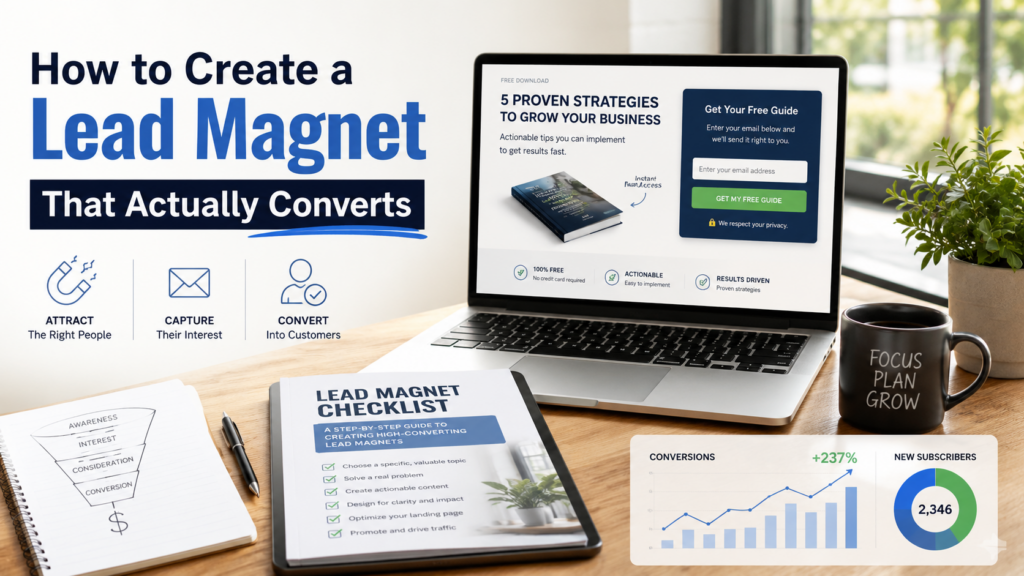
An email list is the single most valuable asset you can build for an online business — and a high-converting lead magnet is the engine that fills it. If you’ve been wondering how to create a lead magnet that people actually want to download, this guide walks you through every step: from choosing the right format to designing, hosting, and promoting it for maximum sign-ups.
The difference between an email list of 200 disengaged subscribers and one of 2,000 eager buyers often comes down to one thing: the quality of the lead magnet used to attract them. Get this right, and every other part of your online business — launches, affiliate promotions, product sales, course enrolments — becomes dramatically more effective.
What is a lead magnet?
A lead magnet is a free resource you offer in exchange for someone’s email address. It can be a PDF guide, a checklist, a mini-course, a template, a swipe file, a quiz, or a webinar — anything that provides genuine value to your target audience and gives them an immediate reason to hand over their contact information.
The word “magnet” is deliberate: a great lead magnet attracts exactly the right people to your list. A weak lead magnet attracts nobody, or worse, attracts the wrong audience who will never buy from you. This guide is about building the former.
If you haven’t yet started building your email list, our complete guide on how to build an email list from zero covers the full strategy — this post zooms in specifically on the lead magnet creation step.
Why your lead magnet determines the quality of your entire list
Many bloggers and business owners make the mistake of treating their lead magnet as an afterthought. They slap together a generic PDF, call it a “free guide,” and wonder why their opt-in rate is 0.5% and their email list never buys anything.
Your lead magnet does three critical jobs simultaneously:
- It filters your audience — the topic of your lead magnet determines who joins your list. A checklist titled “10 Steps to Launch Your Etsy Shop” will attract aspiring Etsy sellers; a guide called “How to Meal Plan for the Week” will attract home cooks. These audiences will respond very differently to your future emails and offers.
- It sets expectations — the quality of your lead magnet is the first real experience a subscriber has with you. A polished, genuinely useful resource signals that your paid products are worth buying. A rushed, generic PDF does the opposite.
- It primes buyers — the best lead magnets don’t just deliver value; they make the subscriber want more from you. They naturally lead toward your paid product or service.
The anatomy of a high-converting lead magnet
Before choosing your format, understand what makes any lead magnet high-converting regardless of type. Every lead magnet that reliably builds email lists shares these five characteristics:
1. Solves one specific problem
The most common lead magnet mistake is being too broad. “The Ultimate Guide to Business” converts poorly because it’s overwhelming and unfocused. “5 Email Templates That Doubled My Client Response Rate” converts well because it solves one precise problem for one specific audience in a concrete way.
The more specific your lead magnet, the higher your conversion rate. Specificity signals relevance — when a visitor sees exactly their problem solved in your opt-in offer, the decision to subscribe takes seconds.
2. Delivers immediate value
Lead magnets that promise long-term transformation are harder to convert than those that promise an immediate win. People are impatient — they want to use your resource today and get a result today, not after 12 weeks of effort.
Frame your lead magnet around speed and immediacy. “The 15-Minute Morning Routine Checklist” outperforms “A Complete Guide to Transforming Your Life” even if the underlying content is similar. Immediacy is persuasive.
3. Has a high perceived value
Your lead magnet should feel like something worth paying for. If someone stumbled across it in a paid marketplace, would they consider buying it? If the answer is yes, you’ve built something with enough perceived value to drive opt-ins. If the answer is “probably not,” it needs more substance or a better presentation.
4. Is deeply relevant to your paid offer
The best lead magnets act as a stepping stone toward your paid product. If you sell an online course about social media marketing, your lead magnet should address a specific pain point within social media marketing — not general business advice. The subscriber who opts in for your free “Instagram Caption Formula” is already pre-sold on the idea of buying your “Instagram Growth System” course.
5. It is easy to consume
People are busy. A lead magnet that requires 4 hours to consume will go unread, and an unread lead magnet delivers zero value — meaning the subscriber has no positive experience with you and is unlikely to buy. Short, scannable, actionable formats consistently outperform long, dense ones.
The best lead magnet formats in 2026
Not all lead magnet formats perform equally for all audiences. Here’s a breakdown of the most effective types, what they’re best suited for, and how long they typically take to create.
| Format | Best For | Conversion Strength | Time to Create |
|---|---|---|---|
| Checklist | Step-by-step processes, audits, routines | Very High | 1–3 hours |
| Cheat Sheet / Quick Reference | Simplifying complex information | Very High | 2–4 hours |
| Template or Swipe File | Writing, email, social media, design | Very High | 3–6 hours |
| Mini e-book / Guide (5–15 pages) | In-depth topic introductions | High | 4–8 hours |
| Email course (3–7 days) | Education-heavy niches, relationship-building | High | 4–10 hours |
| Resource list / Toolkit | Tool-focused audiences, techies, marketers | High | 2–4 hours |
| Quiz / Assessment | Interactive audiences, personality-driven niches | Very High | 5–15 hours |
| Webinar / Video training | High-ticket offers, coaching programs | High (for warm traffic) | 8–20 hours |
| Free trial / Sample | SaaS products, membership sites | Very High | Varies |
| Printable / Worksheet | Productivity, wellness, and education audiences | High | 2–5 hours |
For most bloggers and digital product sellers just starting, checklists and templates offer the best return on the time invested. They’re quick to create, easy to consume, and have consistently high conversion rates across nearly every niche.
How to choose the right lead magnet topic
Choosing the right topic is the single most important decision you’ll make for your lead magnet. A well-designed lead magnet on the wrong topic will still convert poorly. Here’s how to find a winning topic every time.
Start with your most popular content.
If you have a blog or social media presence, look at your analytics. Which posts or content pieces get the most traffic, shares, or comments? Your most popular content tells you exactly what your audience wants most — and your lead magnet should be a deeper, more actionable version of that topic.
Survey your audience
Ask your existing audience directly: “What’s your biggest challenge with [your topic]?” Post this question in your Facebook Group, on Instagram Stories, in a tweet, or send it to your small existing list. The answers will reveal the exact pain points your lead magnet should address. Real audience language also gives you the words to use in your opt-in copy.
Research what competitors offer
Study what other bloggers and businesses in your niche use as lead magnets. Subscribe to their lists and examine the opt-in offers. Identify gaps — what problems are they not solving? What format haven’t they tried? Your goal isn’t to copy, but to understand the competitive landscape and differentiate your offer.
Map it to your paid offer.r
Ask yourself: what does someone need to know or do immediately before they’d be ready to buy my product or service? The answer to that question is your lead magnet topic. If you sell a course on freelance writing, your lead magnet might be “The Beginner’s Pitch Template That Lands Clients” — directly addressing the first hurdle before someone is ready to invest in a full course.
How to create your lead magnet step by step
Step 1: Write an outcome-focused title
Your title is the first — and sometimes only — thing a potential subscriber reads before deciding whether to opt in. It needs to clearly and compellingly communicate a specific outcome.
Weak title: “My Free Business Guide.”
Strong title: “The 7-Point Checklist for Validating Your Business Idea Before Spending a Single Dollar.”
Use numbers where possible (“5 Templates,” “3-Day Email Course”), include the outcome (what they’ll be able to do), and add a time or effort qualifier (“in 10 minutes,” “without any experience”).
Step 2: Outline the content
Keep your outline tightly focused on the single problem you’re solving. Resist the urge to include everything you know — a focused lead magnet that does one thing exceptionally well converts better than a sprawling guide that tries to cover everything. For a checklist, aim for 7–15 items. For a PDF guide, aim for 5–12 pages. For a template, keep it immediately usable.
Step 3: Design it professionally
You don’t need a graphic designer. Canva has hundreds of free lead magnet templates — for checklists, e-books, guides, worksheets, and more — that you can customize with your branding in under an hour. Professional design signals professional content; a well-formatted PDF with a consistent color scheme and clean typography converts significantly better than a plain Word document.
Design tips that elevate your lead magnet:
- Use 2–3 brand colors consistently throughout
- Include your logo or website URL on every page
- Use white space generously — don’t cram content onto pages
- Add visual elements: icons, callout boxes, dividers
- Export as a PDF to preserve formatting across devices
Step 4: Host your lead magnet
Once your lead magnet is created, you need somewhere to host the file so subscribers can download it automatically after opting in. Options include:
- Your email service provider — most platforms (ConvertKit, MailerLite, ActiveCampaign) let you attach a file directly to your welcome email or automation
- Google Drive or Dropbox — host the file and share a direct download link in your welcome email
- Your website — upload to WordPress Media Library and link to it from your thank-you page or welcome email
The delivery method matters less than the speed — subscribers expect to receive their lead magnet within seconds of opting in. Any delay increases the risk that they will forget why they signed up and treat your emails as spam.
Step 5: Create your opt-in landing page
Your opt-in landing page (also called a squeeze page) is where visitors enter their email to access your lead magnet. It doesn’t need to be elaborate — the most effective opt-in pages are often the simplest. Every high-converting opt-in page includes:
- A compelling headline that states the lead magnet’s outcome
- 3–5 bullet points describing what subscribers will learn or receive
- A visual mockup of your lead magnet (cover image of your PDF, screenshot of your template)
- A simple opt-in form — first name and email only; the fewer fields, the higher your conversion rate
- A clear CTA button with action-oriented text (“Send Me the Checklist”, “Get Instant Access”, “Download Now”)
- Social proof, if available (number of subscribers, testimonials from existing subscribers)
Step 6: Set up your welcome sequence
The welcome sequence is a series of automated emails delivered over the 5–7 days after someone subscribes. This is arguably the most important email sequence you’ll ever write — it’s when your subscriber’s attention and interest are at their peak.
A simple, effective welcome sequence structure:
- Email 1 (immediate): Deliver the lead magnet and introduce yourself briefly
- Email 2 (day 2): Share your story — why you do what you do, what you’ve overcome
- Email 3 (day 3): Provide your best free content — a cornerstone blog post, a helpful tip, a resource
- Email 4 (day 5): Soft introduction to your paid product, course, or service — framed as a natural next step
- Email 5 (day 7): Social proof — testimonials, results, case studies that reinforce the value of your offer
How to promote your lead magnet for maximum subscribers
Creating your lead magnet is only half the work. The other half is getting eyes on it. Here are the most effective promotion channels for growing your list with your lead magnet.
Your blog and website
Add your opt-in form or a link to your landing page in multiple places on your website: the sidebar, within relevant blog posts (especially high-traffic ones), a pop-up (timed or exit-intent), the homepage hero section, your about page, and your footer. Every high-traffic page on your site is a lead magnet promotion opportunity.
In-content upgrades — lead magnets that are specifically related to the blog post the reader is already consuming — consistently achieve 20–50% higher opt-in rates than generic sidebar opt-ins. For example, within a blog post about budgeting, offer a free “Monthly Budget Template” as an opt-in rather than a generic newsletter sign-up.
Pinterest is one of the most underutilized channels for promoting lead magnets. Create a set of 4–6 pin designs for your lead magnet using Canva, link them directly to your opt-in landing page, and post them to relevant boards. Pinterest pins have a long shelf life — a well-optimized pin can drive opt-ins for months or years without any additional effort.
Social media bio links
Your Instagram bio, Facebook page, LinkedIn profile, Twitter/X bio, and TikTok bio are all free real estate. Change your link in bio to point directly to your lead magnet landing page, not your homepage. Mention your lead magnet regularly in your content, and include a call to action to grab it via the link in your bio.
Guest posts and collaborations
When you write a guest post on another blog or appear on a podcast, always mention your lead magnet as the call to action at the end. “If you want to dive deeper, grab my free [Lead Magnet Name] at [URL].” This drives targeted traffic from someone else’s audience directly to your opt-in page — and these visitors typically convert at higher rates because they’ve already heard you deliver value.
Paid traffic (once proven)
Once you know your lead magnet converts organically — meaning your landing page achieves at least a 25–40% opt-in rate with warm traffic — you can consider running paid ads (Facebook, Instagram, Pinterest) to scale subscriber growth. Never invest in paid traffic until you’ve proven organic conversion; ads amplify what’s already working, not what’s broken.
Lead magnet ideas by niche.
If you’re still unsure what type of lead magnet to create, here are tested, high-performing examples across popular niches:
| Niche | Lead Magnet Idea | Format |
|---|---|---|
| Blogging / Content Creation | “30 Blog Post Ideas for [Niche] Bloggers” | PDF / Checklist |
| Digital Products | “The Digital Product Launch Checklist” | Checklist |
| Etsy Sellers | “Etsy Shop SEO Audit Checklist” | Checklist / Worksheet |
| Freelancers | “5 Client Pitch Email Templates” | Swipe File / Template |
| Online Course Creators | “Course Idea Validation Workbook” | Worksheet |
| Finance / Budgeting | “Free Monthly Budget Spreadsheet Template” | Template |
| Fitness / Wellness | “7-Day Meal Plan + Grocery List” | PDF Guide |
| Parenting / Mom Blogs | “Morning Routine Checklist for Busy Moms” | Checklist |
| Photography | “Camera Settings Cheat Sheet for Beginners” | Cheat Sheet |
| Small Business | “The 5-Day Email List Launch Challenge” | Email Course |
How your lead magnet fits into your wider business
A lead magnet is the entry point to your email ecosystem — but it’s just the beginning. Once someone is on your list, the goal is to build a relationship and eventually introduce them to your paid offers. Understanding where your lead magnet fits in the bigger picture helps you design it with the end goal in mind.
Here’s how a complete email marketing funnel typically looks:
- Traffic source — blog SEO, Pinterest, social media, or paid ads drive visitors to your opt-in landing page
- Lead magnet — visitor opts in to receive your free resource
- Welcome sequence — automated emails build trust, deliver value, and introduce your paid offer
- Nurture emails — regular broadcast emails keep subscribers engaged and maintain the relationship
- Sales emails — targeted campaigns for product launches, limited offers, or evergreen promotions
Your lead magnet is the top of this funnel. Everything below it — the relationship, the sales, the recurring revenue — depends on getting the top right.
If you’re building a digital product business, your lead magnet and email list become your most powerful sales channel. Read our guide to passive income with digital products to see how email fits into the full income picture, and our overview of what a digital product is if you’re still exploring what to sell.
For bloggers looking to monetize, lead magnets are equally critical — they grow the list that drives affiliate commissions, sponsored post pitches, and course sales. Our guide to making money blogging shows exactly how these pieces connect.
And if you’re using affiliate marketing as an income stream, your email list is far and away your most effective channel for affiliate promotion. Our guide to affiliate marketing for beginners explains how to structure promotions that convert without alienating your audience.
Common lead magnet mistakes to avoid
- Too broad: “Everything You Need to Know About Social Media” attracts no one specifically and helps no one deeply. Narrow the topic relentlessly.
- No connection to your paid offer: A lead magnet about meal planning that feeds into a social media marketing course creates a disconnected subscriber who will never buy.
- Poor design: A visually sloppy lead magnet undermines trust. Invest 30–60 minutes in a clean Canva design.
- Too long: A 60-page e-book is not more valuable than a 6-page guide — it’s just less likely to be read. Brevity is a feature.
- No promotion plan: Build it, and they will not come. Plan exactly where and how you will promote your opt-in before you publish it.
- No welcome sequence: Delivering the lead magnet and then going silent for weeks is how you build a list of people who forget who you are.
Measure and improve your lead magnet performance.e
Once your lead magnet is live, track these key metrics to understand how it’s performing:
| Metric | What It Tells You | Benchmark |
|---|---|---|
| Landing page opt-in rate | How compelling your offer and page are | 25–45% (warm), 10–25% (cold) |
| Welcome email open rate | Deliverability and sender reputation | 50–70%+ |
| Lead magnet download rate | Whether subscribers actually access it | 60–80%+ |
| Sequence email open rate | Ongoing list engagement | 30–50% |
| Click-through rate | How compelling your email content is | 2–5% |
| Unsubscribe rate | Audience relevance and email quality | Below 0.5% |
If your opt-in rate is below 20% with warm traffic, test a different headline, adjust the benefit bullets, or try a different format. If your open rates drop sharply after email 1, your welcome sequence needs work. Treat these metrics as feedback, not judgment — every successful email marketer has tested and iterated their way to a high-converting system.
Your lead magnet is the foundation of everything.
Every successful online business with an email list started with someone creating one lead magnet, setting up one opt-in form, and sharing it with the world. That first step is what separates businesses that grow sustainably from those that rely entirely on social media algorithms and platform policies they don’t control.
If you sell digital products, our guide on creating digital products to sell online is the natural next step after you’ve built your list. If you’re planning to sell an online course, learn how to create one, then use your email list to launch it. And if you’re growing an Etsy shop, ” How to Grow Your Etsy Shop ” shows how email integrates with your shop’s growth strategy.
Build the magnet. Set up the page. Share it consistently. Watch your list — and your income — grow.