


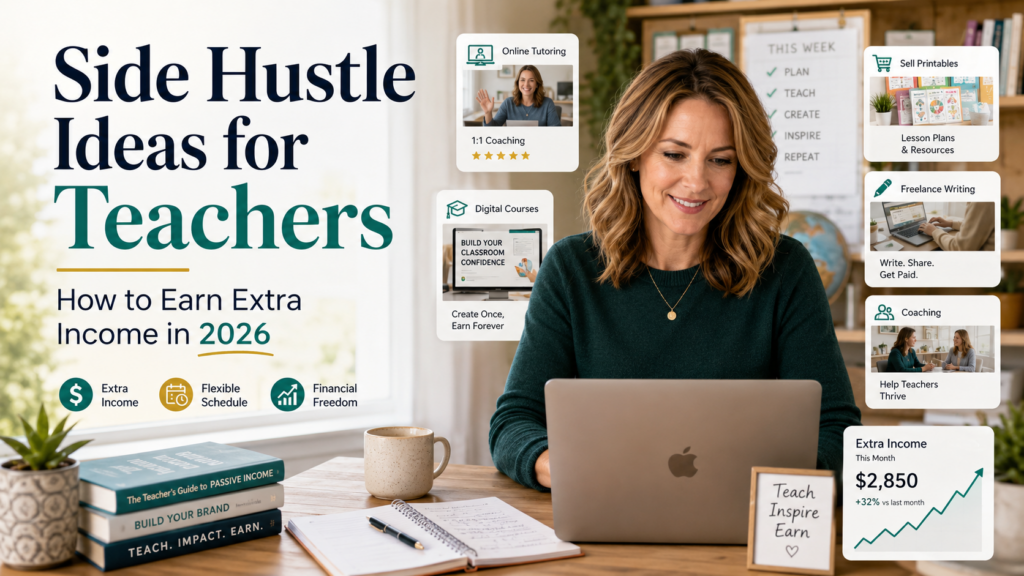
Teachers are among the most talented, versatile professionals in the workforce — and also among the most chronically underpaid. If you’re a teacher looking to supplement your salary with a meaningful second income, you’re sitting on a wealth of marketable skills that the rest of the world genuinely needs. This guide covers the best side hustle ideas for teachers in 2026: flexible, realistic, and tailored to educators’ knowledge and schedules.
Whether you want to earn an extra $500 per month to build savings or you’re working toward eventually replacing your teaching salary, there’s a path here for you. Let’s start with why teachers are uniquely positioned to succeed at side hustles — then get into the specifics.
Why teachers are perfectly suited for side hustles
Teaching develops a specific set of skills that are highly valuable far beyond the classroom:
- Curriculum design — breaking complex topics into digestible, sequential steps is exactly what online course creation requires
- Communication — explaining things clearly to diverse audiences translates directly to writing, tutoring, and content creation
- Content creation — lesson plans, worksheets, assessments — teachers create sellable educational content every day
- Subject matter expertise — deep knowledge in specific academic subjects is highly sought after for tutoring, consulting, and course creation.
- Time management — teachers operate in one of the world’s most demanding time-constrained environments; that discipline transfers directly to running a side hustle
Add to this the natural schedule advantages of teaching — summers off, school holidays, and afternoons free once your marking is done — and you have more opportunity windows than most professionals to build a second income stream. For inspiration on what’s possible, check out our roundup of side hustle ideas you can start this weekend.
1. Online tutoring
Online tutoring is the most immediately accessible side hustle for teachers. You already have subject knowledge, a teaching certification in most cases, and instructional skills. All you need is a reliable internet connection, a decent webcam, and a profile on one of the major tutoring platforms.
| Subject / Level | Typical Rate | Best Platforms |
|---|---|---|
| Primary / Elementary | $20–40/hr | Tutor.com, Superprof, Wyzant |
| Secondary / High School | $30–60/hr | Wyzant, Preply, Varsity Tutors |
| SAT / ACT / Exam Prep | $50–100/hr | Wyzant, Varsity Tutors, TutorMe |
| University Level | $40–80/hr | Chegg, Tutor.com, Wyzant |
| ESL / English | $15–40/hr | VIPKid, iTalki, Preply, Cambly |
| Music Lessons | $30–70/hr | TakeLessons, LessonFace, Direct |
Tutoring just 2 hours per day after school at $40/hour = $400 per week, or roughly $1,600 per month of extra income. During summer holidays, many teachers scale this to full-time hours and earn their entire school-year salary equivalent in 8–10 weeks.
Pro tip: Build a private client base outside of platforms over time. When you tutor through a platform, they keep 20–30% of your rate. Moving long-term clients to private arrangements booked directly through your own website means keeping 100% of your earnings.
2. Sell lesson plans and worksheets on Teachers Pay Teachers
Teachers Pay Teachers (TpT) is the world’s largest online marketplace for educational resources. Teachers sell lesson plans, worksheets, assessments, unit guides, classroom games, and more to other teachers worldwide. If you’ve been teaching for more than a year, you almost certainly have resources you’ve created that other teachers would pay for.
TpT sellers keep 55–80% of each sale, depending on their seller status, and products are typically priced between $1 and $15 per resource, with larger bundles going for $20–50+. Top TpT sellers earn $5,000–50,000+ per year from their stores — entirely passively after the initial creation work.
What sells well on TpT:
- Complete unit plans with all materials included
- Differentiated resources for multiple learning levels
- Seasonal and holiday-themed activities
- Google Classroom and digital-ready resources
- Sub plans (emergency substitute teacher packs)
- STEM and project-based learning activities
The passive income model on TpT mirrors exactly how printables work on Etsy. Our guide to the most profitable printables to sell on Etsy shows how educational content sells on other platforms too — expanding your reach beyond teachers to parents and homeschoolers.
3. Create and sell an online course
While TpT serves a teacher-to-teacher audience, online courses let you sell your knowledge directly to learners — students, professionals, hobbyists, or anyone who wants to learn what you know. This is where teachers can build genuinely life-changing income, because online courses command dramatically higher prices than individual worksheets or lesson plan bundles.
A high school maths teacher could create a course teaching parents how to help their children with secondary maths — and charge $97. An English teacher could create a course on academic essay writing for university applicants — priced at $197. A science teacher with a passion for environmental education could build a course for homeschooling families.
Your subject matter expertise is the product. You don’t need additional qualifications — you already have them. Our complete step-by-step guide to creating an online course with no experience walks you through the entire process, from idea validation to the first sale.
4. Sell printables on Etsy
Beyond TpT, teachers can sell educational and lifestyle printables on Etsy to reach a much broader audience — parents, students, other professionals, and general consumers. Unlike TpT, which serves exclusively educators, Etsy buyers include anyone looking for a useful, downloadable file.
Teacher-made printables that perform well on Etsy:
- Kids’ educational activity packs for home use
- Homework tracker charts and student planner pages
- Classroom decor and organization printables
- Homeschool curriculum supplements
- Reading logs, book report templates, and writing prompts
- Teacher self-care and professional development planners
Our guide to selling digital products on Etsy is a great place to start if you’re new to the platform. Etsy reaches buyers who aren’t teachers — parents, homeschoolers, and education-conscious families represent a massive untapped market for teacher-quality educational resources.
5. Freelance writing and educational content creation
Teachers are skilled writers — and the market for educational content writers is substantial. EdTech companies, curriculum publishers, children’s book publishers, educational blogs, and test prep companies all regularly hire freelance writers with teaching backgrounds to create content. Your expertise gives you a significant edge over general-purpose writers.
Types of freelance writing work suited to teachers:
- Curriculum writing for EdTech platforms like Outschool and Khan Academy
- Educational blog content for parenting and education websites
- Test question writing for standardized test prep companies
- Children’s book writing or educational book contributions
- Corporate training content — your instructional design skills transfer directly to workplace learning
Freelance educational writers typically earn $30–80 per hour or $0.10–0.25+ per word. To land your first clients, read our guide on how to get your first freelance client with no experience. And before setting your rates, our guide to pricing your freelance services will help ensure you don’t undersell yourself.
6. Start an education blog or YouTube channel
Teachers who share their expertise and classroom experience through a blog or YouTube channel can build audiences that generate substantial income through ads, affiliate marketing, digital product sales, and sponsorships. The education niche is wide and engaged — parents, students, fellow teachers, and homeschoolers are all actively searching for content you could create.
Blog content ideas for teachers:
- Study tips and revision strategies for specific subjects
- Classroom management techniques and teacher burnout advice
- How to become a teacher in different countries
- Homeschooling guides and curriculum reviews
- Subject-specific explainers for students and parents
A well-established education blog earning through Google AdSense and affiliate links can generate $1,000–10,000+ per month. Our guide to making money blogging for beginners gives you the complete roadmap to turning your expertise into a content business.
7. Curriculum consulting
Experienced teachers — especially those with curriculum design, special education, or department leadership experience — can consult with schools, homeschool organizations, private tutoring centers, EdTech startups, and corporate training departments. Consultants review and improve curriculum structures, develop new programs, and advise on pedagogy.
Curriculum consultants typically charge $50–150+ per hour or $1,000–5,000+ per project. Your years of classroom experience and results are your credentials. Starting with word-of-mouth referrals from colleagues and your professional network is the most effective way to enter the market.
8. Affiliate marketing for education products
Teachers have enormous credibility when recommending educational tools, books, apps, and resources to parents, students, and other teachers. Affiliate marketing lets you earn a commission every time someone purchases through your referral link — and with an audience of engaged parents or fellow educators, the conversion rates can be very high.
Education-adjacent affiliate opportunities include:
- Online learning platforms like Udemy, Coursera, and MasterClass
- Educational subscription boxes and toys
- Book retailers through Amazon Associates
- Homeschool curriculum publishers
- EdTech apps and software tools
Our guide to affiliate marketing for beginners explains how to earn your first commission and which programs are easiest to start with.
9. Voiceover work
Teachers speak professionally for a living. Their voices are clear, well-paced, and authoritative — qualities that are in high demand for voiceover work on e-learning modules, audiobooks, explainer videos, educational YouTube content, and corporate training materials.
Voiceover artists can earn $100–400 per finished hour of audio, and e-learning narration is one of the most reliably steady markets in the voiceover industry. Getting started requires an investment in a decent microphone ($80–200) and basic recording software. Our breakdown of Fiverr vs. Upwork for freelancers helps you decide which platform best suits your approach to finding your first voiceover clients.
10. Freelance editing and proofreading
English and Language Arts teachers, in particular, have a highly marketable skill in editing and proofreading. Students, authors, bloggers, and businesses all need quality editing services, and your grammar expertise makes you significantly more credible than a general freelancer.
Academic editors who work with university students on dissertations and theses can charge $50–80+ per hour. General proofreading for businesses and blogs typically earns $25–50 per hour. This work is completely flexible — you set your own schedule and work entirely from home.
11. Educational social media content creator
“EduTok” and educational content on Instagram and YouTube are growing rapidly, with creators building audiences of hundreds of thousands by making learning entertaining and accessible. If you enjoy being on camera or creating short-form video, your classroom expertise can translate into a content channel that earns through ads, brand sponsorships, and digital product sales.
Niches that perform well include history explainers, science experiments, language learning, study skills, and teacher-life content. Many teacher-creators earn more from their social media content than from their teaching salary within 2–3 years of consistent posting.
12. Summer school and enrichment programs
Beyond the school year, teachers can run their own summer enrichment programs, intensive revision courses, or camp-style academic workshops. Whether in person or online, these short programs can be priced at $100–$ 500+ per student and run for 1–4 weeks during holidays.
An online summer maths intensive with 20 students at $150 each = $3,000 for a week’s work. A creative writing camp with 15 students at $200 each = $3,000. The overhead is low, the market is consistent, and your teaching qualification means parents trust you immediately.
Comparing the top side hustles for teachers in 2026
| Side Hustle | Startup Cost | Best Time to Work | Income Potential | Passive? |
|---|---|---|---|---|
| Online tutoring | Free | After school, weekends | $800–4,000/mo | No |
| Teachers Pay Teachers | Free | Evenings and holidays | $300–10,000/mo | Yes |
| Online course creation | $0–$100 | Holidays, summer | $1,000–20,000/mo | Yes |
| Etsy printables | Free | Evenings and holidays | $200–5,000/mo | Yes |
| Freelance writing | Free | Evenings, weekends | $500–6,000/mo | No |
| Education blog | $50–$100/yr | Flexible | $500–10,000/mo | Partially |
| Curriculum consulting | Free | Project-based | $1,000–8,000/mo | No |
| Affiliate marketing | Free | Flexible | $200–5,000/mo | Partially |
| Voiceover work | $80–$200 | Evenings, weekends | $500–3,000/mo | No |
| Social media creator | Free | Flexible | $300–15,000/mo | Partially |
How to make the most of school holidays and summer
Teachers have something most side hustlers only dream of: extended, predictable time off. Summer holidays, in particular, represent a 6–8-week window that, used strategically, can produce an entire side income stream from scratch.
A realistic summer side hustle plan for a teacher:
- Weeks 1–2: Research your niche, validate your course or product idea, set up your Etsy or TpT store
- Weeks 3–4: Create your first 10–20 products or record your online course modules
- Weeks 5–6: List everything optimized for SEO, start Pinterest or social media promotion
- Weeks 7–8: Analyze results, iterate on what works, begin building your email list
By September, you could have a functioning digital product business that generates income throughout the school year without your active involvement. For more ideas that complement a teacher’s schedule, our list of 15 realistic passive income ideas you can start with $0 is full of inspiration.
Using keyword research to make your content discoverable
Whether you’re building a blog, an Etsy store, or a TpT shop, understanding how people search online will make your listings and content significantly more discoverable. Don’t overlook this step — it’s the difference between content that gets found and content that sits invisible. Our beginner’s guide to keyword research gives you the tools to do this without any paid software.
Getting started: your 30-day action plan.
The most important principle for teacher side hustlers is: start with one thing and do it well. The biggest mistake is spreading effort across too many ideas simultaneously. Pick the option that best matches your skills, available time, and income goals, and commit to it for at least 60–90 days before evaluating results.
For most teachers, the fastest path to income is online tutoring (start earning within days) or selling resources on TpT (start earning within weeks). Once you have momentum and your first income is coming in, layer in a more passive stream, like Etsy printables or an online course, during the next school holiday.